KACHEMAK BAY BIRDERS
***TRIPS/Events
George has cancelled the Sea Duck Survey for this year!
George Matz said, “So, given the persistence of the cold weather and that some boats and birders won’t be able participate this weekend, I think the only option is to cancel the Sea Duck Survey for next weekend and the year. “
March 7th or 8th—Sea Duck Survey is postponed!Alternative days: March 14th or 15th George Matz writes:
April to end of May—Shorebird Monitoring. Leader: George Matz.
May 30th—Trip to the Northfork Rd. Meet at 7:00 am. Leaders: Michelle Michaud and Gary Lyon.
June—Trip to Seldovia (Details coming next spring.)
2025 CHRISTMAS BIRD COUNT
Summary of the 126th Christmas Bird Count (CBC) – Homer, Alaska (Dave Erikson)
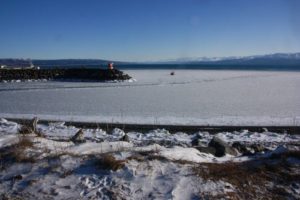
The 126th Homer Christmas Bird Count was conducted on Saturday, December 20, 2025 (referred to as “Count Day”), after a month-long cold spell, which resulted in extensive sea ice buildup along the northern shoreline of Kachemak Bay and the eastern side of the Homer Spit. The weather on Count Day was below freezing temperatures, clear skies, and little wind. Viewing conditions were good to excellent.
On morning of count day, 31 volunteers gathered at the Alaska Maritime National Wildlife Refuge Headquarters (formerly the Islands and Ocean Visitor Center) at 8:30 AM to divide into teams. After an organizational meeting, each team then departed to identify and count all birds within their assigned count areas within the Homer Count Circle, a 15-mile diameter circle centered at the base of the Homer Spit. The teams met back at Headquarters at 4:30 PM to add up the results of the all-day count. An additional 12 other volunteers, referred to as feeder-watchers, stayed at home to monitor their bird feeders and recorded the maximum number of each species that visited their bird feeders throughout the day. Two volunteers from Eagle River and two from Palmer came down specifically to help with our bird count.
Total number of species for Count Day was 69, above the average (65) for the last twenty years. Key highlights for the count included:
- first record of a Wilson’s snipe,
- third occurrence of a fork-tailed storm-petrel,
- five species of woodpeckers, and
- four species of owls
Four additional species were recorded during Count Week, the 3-days before and after Count Day. Total individual birds totaled 4,144, half of the number seen last year. Numbers of individual birds on count day can vary among years depending on the weather and presence or absence of key species, such as waterfowl or shorebirds.
Heavy sea ice conditions in the inner bay were a large factor in the relatively low number of birds for the count. Mallard and greater scaup, typically some of the most abundant birds on the count, were largely absent, due to sea ice covering much of their prime foraging habitat. We found no greater scaup and only one mallard (Count Week) on this year’s count. Overall, bird numbers in upland areas around Homer were also low in comparison to previous years. Twelve species on Count Day were represented by only one individual bird.
The most abundant species was the American crow (875), quite common throughout town, followed by the rock sandpiper (562), which typically roosts in the Homer Harbor during high water. The relatively low number of rock sandpipers in comparison to previous years is likely the tidal stage during the count and sea ice cover of their typical roosting areas. Black scoters (407) were the most abundant waterfowl.
White-winged crossbill (20) numbers are still low after a major influx two years ago. No red crossbills were found this year. Pine siskins (109) were dispersed in small flocks throughout the count area, but numbers were low.
A big thanks go out to all the volunteers, both in the field and at feeders, who contributed to the success of this year’s count. Special thanks also goes out to the Alaska Maritime National Wildlife Refuge Headquarters and staff, and especially Lora Haller, for providing the meeting place and cosponsoring the event. Other sponsors include the National Audubon Society and the Kachemak Bay Birders.
As an important footnote, we Kachemak Bay Birders would like to say a big THANK YOU to Dave for coordinating and compiling the CBC for 49 consecutive years here in Homer!
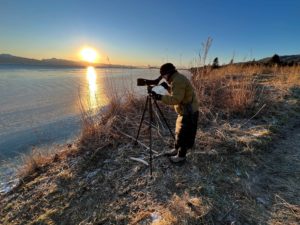
Photo: Nancy Lord
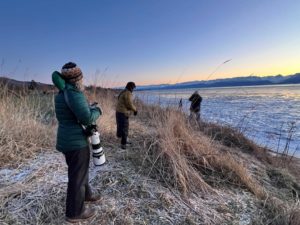
Photo: Nancy Lord
The Kachemak Bay Birders and Alaska Maritime National Wildlife Refuge conducted
mid-winter bird walk this past Saturday, February 14, from 1– 3:00 PM on the Homer
Spit. The walk began at the base of the Spit and covered much of the west side of the
Homer Spit, Louis’s Lagoon (mid-Spit), the Homer Harbor and Deepwater Dock, and the
open water areas in front of Land’s End Resort at the tip of the Spit. The weather was
overcast and chilly, but with little wind. Very good conditions for birding this time of year.
The tide was flooding with approximately half the tide flats exposed.
A total of nine birders participated in the walk. The highlights of walk included a flock of
seven snow bunting, three Eurasian wigeon, and 70 American wigeon in the Louis’s
Lagoon area on the eastern side of the spit. Other small flocks of snow bunting were
seen in the area, but observers didn’t get a good count before they disappeared into the
salt grass. A large, dense flock of at least 200 greater scaup were also observed in the
shallow nearshore waters on the easter side of the Spit.
One of the goals of the walk was to find some of the Steller’s eiders, which have
frequently been seen along the eastern shoreline of the Spit near the Homer Deep
Water Dock. Small numbers of this beautiful sea duck have been seen on numerous
occasions in the past couple of weeks, but unfortunately, we could not locate any during
the afternoon bird walk.
The most abundant bird was the rock sandpiper, which is typical for this time of year.
Rock sandpipers often roost along the northeast shoreline of the inner Homer Harbor
during high tide during the winter months. Due to the stage of the tide, the rock
sandpipers seen were feeding on the mudflats of Mud Bay and Louis’s lagoon.
A total of 26 species and nearly 1,800 individuals were documented during the two-hour
walk:
Surf Scoter – 150
Black Scoter – 3
White-winged Scoter – 2
Long-tailed Duck – 25
Bufflehead – 4
Common Goldeneye – 2
Red-breasted Merganser – 3
Rock Pigeon – 55
Rock Sandpiper – 1000
Marbled Murrelet – 9
Pigeon Guillemot – 1
Common Murre – 5
Short-billed Gull – 7
Glaucous-winged Gull – 40
Gulls, unidentified – 100
Horned Grebe – 8
Common Loon – 4
Loons, unidentified – 2
Pelagic Cormorant – 24
Bald Eagle – 15
Black-billed Magpie – 2
American Crow – 45
Snow Buntings – 7
Song Sparrow – 2
-
Mallard 38
-
Greater Scaup 1
-
Harlequin Duck 7
-
Surf Scoter 10
-
White-winged Scoter 2
-
Long-tailed Duck 43
-
Bufflehead 4
-
Common Goldeneye 11
-
Barrow’s Goldeneye 3
-
Red-breasted Merganser 8
-
Ring-necked Pheasant 1
-
Rock Pigeon (Feral Pigeon) 20
-
Rock Sandpiper 1500
-
Marbled Murrelet 2
-
Pigeon Guillemot 2
-
Common Murre 4
-
Short-billed Gull 50
-
Glaucous-winged Gull 100
-
Horned Grebe 5
-
Common Loon 2
-
loon sp. 2
-
Pelagic Cormorant 27
-
Bald Eagle 6American Crow 50
-
Gray-crowned Rosy-Finch 80
Spit Trip Report: 11-15-25
KBB Bird Walk Results – November 15, 2025 from Dave Erikson
The Kachemak Bay Birders conducted its last bird walk of the year this past Saturday,
November 15, from 10:00 AM until noon. The walk began at the base of the Homer Spit
and covered much of the west side of the Homer Spit, the Homer Harbor, and the open
water areas in front of Land’s End Resort. The weather was clear, the tide was high and
the winds were calm. Ideal conditions for birding this time of year!
A total of fourteen birders participated in the walk, including two from the Soldotna area
who heard about the event and made the trip down the highway.
The highlights of walk included a lone short-eared owl that flew right in front of the group
at the beach at Mariner Park with the sun to its back illuminating its beautiful feathers.
Also, a lone shearwater seen off Land’s End feeding with the kittiwakes. Shearwaters
are typically migrating to their breeding grounds in the Australia and New Zealand by
this time of year. Several more shearwaters were seen in the same general area during
the afternoon following the walk.
A total of 28 species and nearly 800 individuals were documented during the two-hour
walk:
Surf Scoter – 20
Black Scoter – 88
White-winged Scoter – 19
Long-tailed Duck – 3
Bufflehead – 7
Common Goldeneye – 1
Red-breasted Merganser – 1
Ring-necked Pheasant – 1
Rock Pigeon – 115
Rock Sandpiper – 250
Marbled Murrelet – 4
Pigeon Guillemot – 3
Common Murre – 1
Black-legged Kittiwake – 10
Short-billed Gull – 4
procrastinated on reporting!) at 8:00pm, at Homer Reservoir. A couple of
us got there a bit early and were greeted by a Great Horned Owl calling
in the distance. Eventually we were joined by three more intrepid
birders. However a very light mist built to an actual light rain in the
next 30 minutes. We called all three expected owl calls and got no
response. Owls do not fly in the rain because their feathers are not
waterproof, so likely reason.
After 30 minutes of hearing nothing, getting wet and common sense
prevailing, we gave it up.
Next year!
Gary Lyon
Last Saturday morning, September 20th , the Kachemak Bay Birders sponsored its
monthly bird walk at Mossy Kilcher’s Seaside Farm, located approximately Mile 5 East
End Road in Homer. Seaside Farm is one of the unique birding hotspots in the Homer
area. Open fields and extensive landscaping create a great place to find passerines and
other land birds. Access to the tidal flats of Kachemak Bay also makes it a great place
to look for marine-oriented birds.
Birders met at 8:00 AM, just after sunrise. Fog, light rain and low light levels made for
poor visibility around the farm, but a few birds were located in the trees and shrubs after
it got a little lighter. However, most bird activity was found near some of the many bird
feeders on the farm.
A trip down to the shoreline of Kachemak Bay yielded a few additional species. The tide
was low, so extensive mudflats were exposed in front of the bluff. Mallards were
observed feeding at the water’s edge and flying low over the flats. Bald eagles were
seen perching on boulders along the outer limits of the flats. Song sparrows were found
in the beach grass at the edge of bluff. Fox sparrows were seen and head in the mixed
forest and shrub habitats on the path down to the beach.
A total of ten species were documented during the two-hour walk:
Mallard – 200+
Bald eagle – 4
Black-capped chickadee – 3
Ruby-crowned kinglet – 3
Fox sparrow – 2
Dark- eyed junco – 1
Golden-crowned sparrow – 2
Song sparrow – 3
Orange-crowned warbler – 1
Yellow warbler – 1